Ep. 304: Fascinating Lies Behind Our Favorite Ads
Fascinating Lies Behind Our Favorite Ads
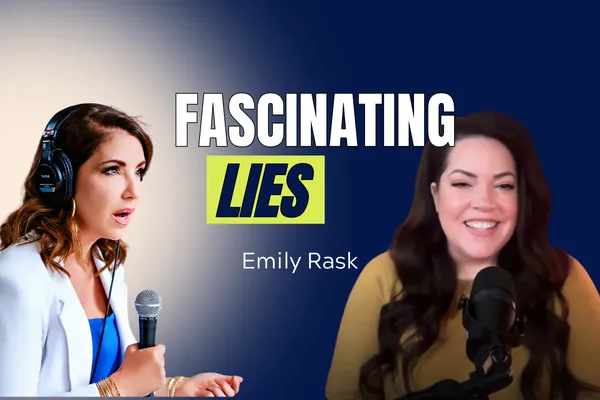
Emily Rask and her husband tried for a baby for years. Three fertility clinics. A move from Washington State to Arizona because a clinic there gave first responders half off, and her husband is a firefighter. They still spent more on travel than they saved. Ten pregnancies lost.
By the time she lost her last one in March of last year, the room in her house that was supposed to be the nursery had turned into storage for bags of donation clothing, the kind of stuff you can't look directly at. She needed to clean it out. She thought if she cleaned out the room, she could start cleaning out her brain too.
What she built there instead is a podcast that hit No. 9 in Marketing on Apple Podcasts before she'd released a single full episode.
A Decade Selling the Same Lies She Now Exposes
Emily spent ten years scaling brands across finance, wellness, and the wine industry. She has a series seven, an analytical brain, and a decade of watching companies craft messaging that wasn't entirely true. That's the whole premise behind Lies We Bought: she picks a slogan or a cultural touchstone, traces where it came from, follows the money, and tells you who got rich.
She almost didn't put her face on camera. A friend, a producer in LA named Michon Nicks, talked her into it. She launched on 11/11 last year, on a Tuesday, partly for the angel numbers and partly because Tuesdays test well. The show has been, in her words, the most cathartic thing she's ever done.
Breakfast, Diamonds, and the Disease a Mouthwash Company Invented
Her first episode was about cereal. The Kellogg brothers ran a sanitarium that served bland food to keep patients from doing, in Emily's words, "naughty things" to themselves. One brother broke off and put sugar on the bland food, and that's the cereal aisle you shop today. The phrase "breakfast is the most important meal of the day" traces back to Edward Bernays, the father of modern propaganda and Sigmund Freud's nephew, who was hired by a bacon company and simply asked a room full of doctors if they'd agree breakfast was a good idea. They said sure. He printed it as a doctor's consensus.
Bernays also invented "four out of five doctors," and he's the reason women smoke in public without a second thought. He staged an Easter parade where women lit cigarettes on camera and called it "torches of freedom."
Then there's Edna. Listerine was originally sold as a surgical antiseptic and floor cleaner, and at one point pitched as a cure for gonorrhea. A company scientist went looking for a new use and found the word "halitosis" in a dictionary. They invented a fictional woman named Edna, always the bridesmaid, never the bride, because of her bad breath. There was no disease. There was a word nobody used, and a company that needed one.
The rest of the myths fall the same way. Diamonds aren't rare. De Beers manufactured scarcity, reportedly dumping diamonds in the ocean to keep supply low. Ten thousand steps came from a 1960s Japanese pedometer called the manpo-kei, not a study. Eight glasses of water a day is a wartime ration guideline stripped of its context. Sugar making kids hyperactive is mostly parent perception, not data.
Growing Up Mormon in Utah
Emily grew up Mormon in a small Utah town near dairy farms and a reservation, in what she describes as a bubble with almost no cultural exposure. Girls dated boys who'd leave on missions at eighteen, married young, and a woman in her thirties who'd never married got called an old maid, sometimes as a joke about whether she had bad breath.
She left the church the day she turned eighteen and moved out. She couldn't stomach the idea of being what Mormons call a Jack Mormon: someone who's "bad" all week and shows up good on Sunday. She loves coffee, and coffee is banned while the church holds stock in Coca-Cola and Pepsi. Nobody could ever explain that one to her satisfaction.
The bigger crack came from tithing. Members hand over ten percent of gross income, sometimes producing a W-2 so a bishop can check the math. In 2023, the SEC went after the LDS Church for hiding more than thirty billion dollars across thirteen shell LLCs run through an entity called Ensign Peak Advisors, exposed by a whistleblower named David Nielsen. The church said it didn't know. Emily doesn't buy it. They started the LLCs.
What Still Gets Under Her Skin
The topic that actually made her angry was "This Is Your Brain on Drugs." It came from the Partnership for a Drug-Free America, built by an ad agency, not addiction specialists or neuroscientists. Fear marketing, she says, is the laziest kind of marketing there is. It didn't stop a generation from questioning authority. It taught them to.
She's also watching the supplement industry she used to trust. Thorne, a brand she and I both use, just sold to GNC. None of it is regulated by the FDA. She looks for NSF or USP certification now, the only proof that what's on the label is actually in the bottle. She won't touch a face cream with collagen in it: the molecules are too big to absorb, and every brand selling it knows that.
Even "Got Milk" and "Beef. It's What's for Dinner" are government-run campaigns, not brand marketing. Ranchers took the beef campaign to the Supreme Court and lost, six to three, because the First Amendment protects citizens from the government, not the other way around.
Emily still won't sell out. Supplement companies keep reaching out to advertise on her show. She sends them a link to her episode about supplements and never hears back.
Find her at lieswebought.com, and be nice about the Patreon. She'll tell you herself: marketing is her strength, Patreon is not.
Listen to the full conversation with Emily Rask on Culture Changers Podcast.
xo,
Allison
Watch the full episode here:
Allison Hare's Links
Schedule a FREE podcast clarity call with me- Your future audience is out there. Talk to them!
DOWNLOAD the free podcast equipment guide- No guesswork, no google rabbit holes, start recording today
Feedback and Contact:: [email protected]