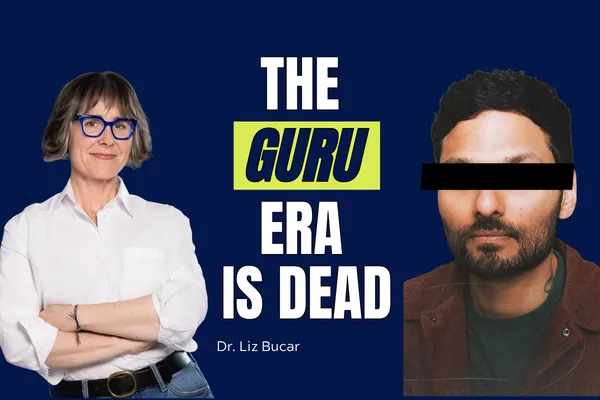
Ep. 298: The Guru Era is Dead
The Guru Is Dead. So What Now?
We've been chasing wellness for a long time. Most of us hit the markers — the BMI, the bloodwork, the gym habits — and still feel like something is missing. That feeling is the starting point for Dr. Liz Bucar's new book Beyond Wellness, and it's the thread running through every minute of this conversation.
Liz is a religious ethicist and professor at Northeastern University who has spent more than 25 years studying religion as an outside observer — and only recently started asking what it might offer her personally. She's a self-described skeptic and seeker with no religious affiliation, which makes her the exact right person to ask: what are we actually looking for when we look for a guru?
The Trust Recession
The wellness world is in freefall. Deepak Chopra, Jay Shetty, the whole category of charismatic, platform-built spiritual leaders who offered beautiful, vague answers — people are done. Liz calls the Jay Shetty interview that went sideways a crack in the facade that finally became visible. The advice was always vague enough to mean whatever you wanted. Like a horoscope. Like an AI trained on your own preferences, mirroring you back at yourself.
There's also something uncomfortable underneath all of it worth naming: Liz points out that part of the appeal of Deepak Chopra and Jay Shetty to white American audiences is a kind of Orientalism — a romantic projection of Eastern wisdom onto South Asian men who learned early how to play into that fantasy. It's not just credulity. There's a latent racism in who we decided to trust.
Wellness Is Too Low a Bar
The title of Liz's book, Beyond Wellness, came from a question she kept asking herself. She was hitting all the wellness markers. Still felt something missing. So she started asking what religious traditions actually say about human flourishing — and found that the answer is far richer than BMI targets and cortisol management.
For women, the wellness ideal is bodily perfection. For men, it's optimization. Liz argues both are an anemic version of what it means to be alive. Real wellbeing includes the full range of emotions — grief, rage, despair. It includes community. It includes, yes, death.
Food, Moralizing, and Bad Protestant Theology
One of the most unexpected turns in this episode is Liz's argument that our culture's obsession with clean eating and food guilt has religious roots. She traces it back to Sylvester Graham — yes, the Graham cracker guy — whose 19th-century ministry explicitly tied diet to morality. Kale became sacred. Pasta became profane. The idea that food can be toxic or polluting is a religious category. We just stopped noticing where it came from.
Liz was finishing the chapter on disordered eating for Beyond Wellness the same week her daughter was hospitalized for dangerously low weight from an eating disorder. It's not abstract for her. It wasn't for me either — I told Liz on this episode that a single question from a tarot card reader did more to reverse my orthorexia than years of therapy and church-shopping ever did.
Ayahuasca in an Oregon Yurt
Liz is straight-edge. Doesn't drink. The story of her friends laughing at her accidentally eating a pot brownie in college basically tells you everything. So when she decided to include a psychedelics chapter in Beyond Wellness, she planned to observe. Interview people. Take notes.
Then she ended up doing ayahuasca. Three times a day. For three days. In a yurt in Oregon. With no food.
She went to a Santo Daime community — a legal ayahuasca church in the US that emerged from Brazil and treats ayahuasca not as a drug or even medicine, but as a sacrament. Like the Eucharist. The religious container was the whole thing. She'd never have gone to a retreat in Peru, she said — too many stories of fake shamans and abuse. But the Santo Daime community felt safe immediately. Medical intake. Guardians watching over participants. Hymns in Portuguese that gave her something to hold onto.
What came up on ayahuasca: her father's death. The night she administered his hospice medication while he died, not peacefully, agitated at the end. She'd been avoiding thinking about it. The ayahuasca didn't let her avoid it. She went through three boxes of tissues. And she came out the other side training to become a death doula.
Dying Well Is Part of Living Well
This is the thesis that runs underneath everything in this conversation. The wellness industry is built around avoiding death. Brian Johnson is out here literally trying not to die. And Liz argues that is exactly the problem. Dying well — having the death you want, with the people you want around, having prepared for it — is part of what it means to flourish as a human. Religious traditions understand this. The wellness industry has no interest in it.
Sangha, Community, and Showing Up
By the end of this conversation, we landed somewhere that felt important. We've been sold the idea that wellness is an individual pursuit. Liz thinks that's wrong — that isolation isn't an accident, that we've been systemically separated from each other, and that the fix isn't a better morning routine. It's community. Real community where you're not just extracting from other people, but showing up for them. Inconveniencing yourself for them.
Liz told a story about cooking dinner every Tuesday during COVID for her neighbors who were ER doctors. Nobody knew. It wasn't a post. It was just service. That's what she means by sangha. Not just who shows up for you. Who you show up for.
Beyond Wellness is available for order now.
Connect with me on Instagram and YouTube.
Ready to build your own podcast platform? Book a free clarity call with Allison at allisonhare.com/freecall.
Watch the full conversation here:
Allison Hare's Links
Schedule a FREE podcast clarity call with me- Your future audience is out there. Talk to them!
DOWNLOAD the free podcast equipment guide- No guesswork, no google rabbit holes, start recording today
Feedback and Contact:: [email protected]