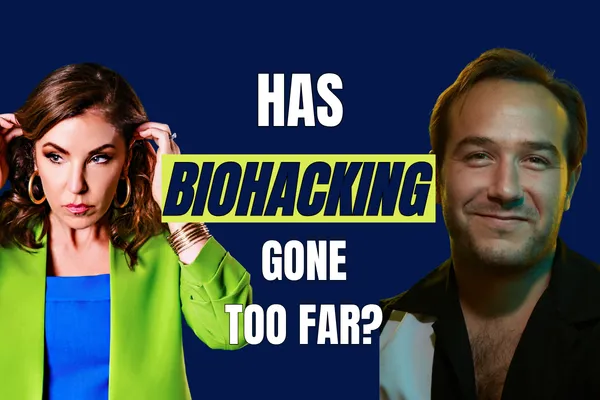
Ep. 295: Has biohacking made us lonely? with Chris Schembra
Biohacking Made Us Lonelier: Here's Why
We're doing everything right. We're tracking our sleep with wearables, optimizing our macros, cold plunging, stacking supplements, taking nootropics to sharpen focus, and quantifying every metric that could possibly make us better.
We've never been more optimized.
Yet we've never been more lonely.
There's something deeply broken about that math. And Chris Schembra—someone who has spent the last decade undoing optimization culture—thinks he knows what it is. It's not that biohacking is bad. It's that we've biohacked our way into a corner where connection, meaning, and intimacy have become so inefficient that we've engineered them right out of our lives.
The Convenience Trap
We've made modern life easier in almost every measurable way. Groceries arrive at your door. You can send a gift card with AI-written text. You can avoid ever being truly alone by opening any app.
But here's the thing: easy and optimized are not the same.
Easy suggests relief. Optimized suggests we've engineered every inconvenience out of human connection—and in doing so, we've engineered out the meaning itself.
Think about your last check-in with a close friend. Did you call them? Or did you watch their Instagram story and assume you knew how vacation went? Did you pick flowers and drive across town to deliver them for their birthday? Or did you send a gift card because it was faster?
We've made it easier to click like on social media than to actually call someone. We've made it easier to outsource our emotions to chatbots, therapists, and streaming services than to sit in our own thoughts and develop an original idea. We've made it so efficient to numb ourselves—through screens, through apps, through the promise that the next vacation will finally fix us—that we've forgotten what it feels like to just be okay with what's inside.
And here's the kicker: tech companies have architected all of this deliberately. They call us "users" in their terms of service because they've designed products that make us exactly that—consumable, predictable, profitable.
The Loneliness Paradox
We live in the most connected time in human history. You can have 2,000 followers on LinkedIn. You can attend networking events every week. You can swipe through dating apps and match with hundreds of people.
And yet: you have nobody to call at 3 a.m.
This isn't accidental. Social media platforms were built on research from 1973—Mark Granovetter's groundbreaking study called "The Strength of Weak Ties." Granovetter found that most job opportunities and creative breakthroughs come through distant connections, not close ones. So platforms like LinkedIn, TikTok, and the For You page were architected entirely around weak ties. They work. Eighty-seven percent of new jobs are found through second-degree connections.
But they completely miss the point about what humans actually need.
You can have a thousand weak ties and still feel completely isolated. Weak ties are transactional. They're about information flow. They're about opportunity. They're not about being known. They're not about being held when you show up chaotic. They're not about walking through seasons of life together.
What Earned Intimacy Actually Requires
There's a story that perfectly illustrates this. Three guys—Andy, John, and Carlos—started having breakfast together at a restaurant in New York. It was nothing fancy. Just breakfast. But they kept showing up. Week after week.
Eventually, they invited other people. They started having dinner parties. Then Friday morning coffees. Quarterly happy hours. Volunteer days. Not optimized networking events. Just repeated, intentional time together.
Seven years later, there are about 100 people in what they call the League of Gentlemen. Not everyone knows everyone. But there's a core group that truly shows up for each other. They walk through seasons of life together. They celebrate wins. They hold each other through loss. They know each other not just on LinkedIn, but in all your chaos and mess and humanity.
That's earned intimacy.
And here's what it required: inconvenience. Repeatability. Duration. Vulnerability over time. It required saying no to other things. It required showing up even when you didn't feel like it. It required being willing to be known—really known—which means being willing to be rejected.
You can't optimize that. You can't scale it. You can't outsource it to an algorithm.
The Three Pillars
Chris has the serenity prayer tattooed on his arm. It's been there since early sobriety—a literal mark of the framework that saved his life:
"God grant me the serenity to accept the things I cannot change, the courage to change the things I can, and the wisdom to know the difference."
Most people read that as spiritual advice. But it's actually a practical design tool for how to live.
Serenity to accept is about relinquishing control. It's about knowing that you are enough. That there are things you simply cannot change. And that's okay. It's about presence and self-acceptance.
Courage to change is the flip side. If there's something you want to shift in your life, go do it. Don't wait for permission. Don't wait for the perfect moment. Just move.
But here's the part we miss: life isn't a choice between acceptance and action. Life is both. And, not or.
The wisdom to know the difference—that's the real skill. We live in a discernment crisis. We have more information, more suggestions, more people telling us what to do than ever before in human history. But we've stopped asking the hard questions: Which knowledge should I consume? Whose stories are worth studying? Which suggestions deserve my attention? Which optimizations actually matter?
These are judgment calls. Taste. Curation. Discernment. These will be the most valuable skills of tomorrow.
The Inconvenient Way
At the end of the conversation, Chris makes an offer that feels almost archaic in its sincerity. If you're lonely. If you're scared you're replaceable. If you're tired of the optimization trap. Reach out. Come to the dinner table.
"I'm doing 49% of the work by offering it," he says. "It's up to you to do 51% of the effort to show up. But if you do that, folks, the inconvenient way, I can promise you a lifetime of riches. Not monetarily, but network and emotion and a new philosophy about life."
Here's what strikes me: he's not selling ease. He's selling effort. He's offering connection that requires you to actually show up, be vulnerable, get known in your chaos, and stay.
That's the opposite of optimization.
It's the opposite of a click. It's the opposite of efficiency. And maybe—just maybe—it's exactly what we've been missing all along.
The Choice Is Yours
We've optimized ourselves into a corner. But we can optimize our way out.
It starts small. It starts with choosing the inconvenient thing. Pick flowers you drive across town to deliver instead of sending a gift card. Make the phone call instead of clicking like. Take one day off from the gym to have coffee with a friend instead of hitting your step goal. Skip the networking event and go deep with one person you actually want to know.
These aren't big gestures. They're friction. They're inconvenience. They're exactly what the optimization culture has trained us to avoid.
And they might be exactly what saves us from the loneliness we've biohacked ourselves into.
Listen to the full conversation with Chris Schembra on Culture Changers. He's been on four times for a reason.
xo, Allison
Connect with me on Instagram and YouTube.
Ready to build your own podcast platform? Book a free clarity call with Allison at allisonhare.com/freecall.
Allison Hare's Links
Schedule a FREE podcast clarity call with me- Your future audience is out there. Talk to them!
DOWNLOAD the free podcast equipment guide- No guesswork, no google rabbit holes, start recording today
Feedback and Contact:: [email protected]