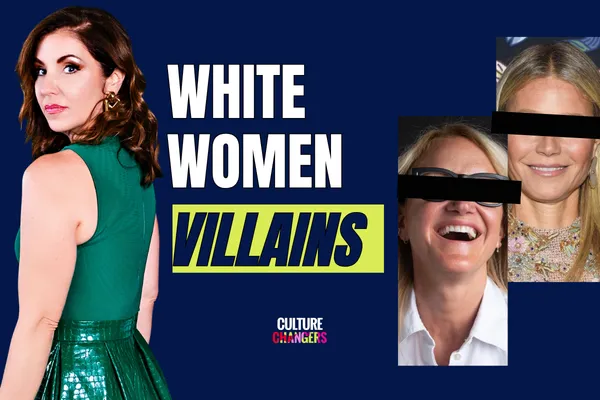
Ep. 294: White Women Villains
White Women Villains: Why We Destroy the Female Leaders We Say We Want
We all know the names. Mel Robbins. Brené Brown. Gwyneth Paltrow. Reese Witherspoon. Hillary Clinton.
They're white. They're rich. They're powerful. And they represent leadership...real, visible, unapologetic leadership...in the spaces we say we want women to occupy: personal development, wellness, politics, culture.
And yet the moment these women actually succeed, the moment they build something massive and undeniable, we begin the takedown. We don't just critique them. We destroy them.
And we do it in a way we literally do not for men.
The Double Standard Is Real
We want female leaders. Powerful ones. But not too powerful. We want them successful, but not too rich—because then they're "too privileged," too inaccessible. We want them vulnerable, but also perfect. Authentic, but without a single blind spot. We want them to contradict themselves, but only in ways we find palatable.
The second they miss the mark—appropriating an idea, selling a product, being flawed, contradicting themselves—we label them grifters. We pile on. We drag them through Reddit and Threads. We make them trend for the wrong reasons. We write thousand-word takedowns explaining why they don't deserve the platform they've built.
And the energy behind it? It's different than it would be if they were men.
The Brené Brown Case Study
I love Brené Brown. I've read her books, watched her specials, cried through her work. She changed my life in real, tangible ways. She helped millions of people understand vulnerability, shame, and connection in a language we didn't have before. She has a PhD. She's backed by research, data, and academic rigor.
Then I saw her trending on Threads.
The charge: she appropriated black feminist theory. She took concepts from bell hooks, Audre Lorde, Patricia Hill Collins—established work, important work—and packaged it as her own. Dr. Yolanda Yazeed said it plainly: "Black women don't have the luxury of vulnerability that Brené Brown promotes."
That's a legitimate point about privilege and access and whose stories get centered and whose get credit.
But then the pile-on happened. People started calling her a fraud. A grifter. A charlatan. The nuance disappeared. It became binary: she's either a genius or she's a con artist.
At what point do you go from beloved to canceled?
The Grifter Accusation (And Everything Else)
Mel Robbins gets it too. Gwyneth Paltrow's entire wellness empire is treated like a scam. Reese Witherspoon gets dragged for everything from her voice to her privilege. Hillary Clinton—well, we all know that one.
The accusations vary: appropriation, fraud, tone-deafness, exploitation, privilege. And sometimes they're right. Sometimes these women do miss something. Sometimes they are complicit in systems that harm people. That's worth naming.
But here's what I'm seeing: the energy of the critique is not proportional to what they actually did. The moral policing is intense. The certainty is absolute. There's no room for "she did something wrong and she also did something good." There's no space for "she's learning." There's no possibility that complexity exists.
It's Not About Ethics. It's About Envy and Gender.
Look, I'll say it: I want Mel Robbins' career. Mel's 55. I'm 51. And I'm sitting here thinking, there's still hope for me. But I also think: if I had her resources, her platform, her decade-long head start in the wellness space, I might make some of the same choices she did. I might miss some things. I might get it wrong.
Do I love seeing people win? Yes. Do I sometimes feel envious of their success? Also yes.
And I think a lot of what we're calling "ethics" right now is actually envy dressed up in the language of accountability. It's gender-based piling on. It's us saying: "You can be successful, but only if you're also humble about it. You can have money, but only if you feel guilty. You can be powerful, but only if you stay small enough that we don't feel threatened."
We cannot dismantle patriarchy by perfectly policing women.
The Wellness Grifter and the Over-Optimization Backlash
There's legitimately a conversation to have about wellness culture and grifting. The supplement industry isn't regulated. The promises aren't always tested. There are real risks. And yes, some people are profiting off false claims and genuine harm.
But not everyone selling a product is a grifter. Not everyone building a business in the wellness space is a con artist. Some of them genuinely believe in what they're doing. Some of them are just... running a business. In capitalism. Like everyone else.
And we're not having that conversation with men.
The Real Thing I Want to Say
These women are mirrors. Not heroes, not villains. Mirrors.
They're reflections of how we operate in society, what we value, what we fear, what we want. And the way we treat them—the moral policing, the character assassination, the pile-on—that says something about us. It says we're afraid of female power. It says we don't know how to hold complexity. It says we're looking for permission to feel envious by turning it into righteousness.
What if we redirected that energy? What if, instead of commenting on Reddit about how Mel Robbins is a fraud, we asked ourselves: What am I actually feeling right now? What do I want that she has? How can I use this energy to build something real in my own community?
Systemic change doesn't happen online. It happens in our circles, in our communities, in the way we show up for each other.
Don't Be the Best Kept Secret
Here's the thing: most of us have something to say. Most of us have a message, a mission, something that could matter. But we don't say it because we're afraid of being judged. We're afraid of being wrong. We're afraid of being called a grifter or a fraud or a charlatan.
And the truth is: we probably will be. Someone will judge us. Someone will be wrong about us. Someone will misunderstand.
But the alternative—staying silent, staying small, not singing our song—that's the real tragedy.
Your voice matters. Your message matters. Even if it's imperfect. Even if you get some things wrong. Even if people criticize you.
So here's my ask: stop piling on women who are doing the thing. Start doing the thing yourself. Stop policing the tone. Start changing the system. Stop looking for permission to feel righteous. Start creating something real.
And if you need help with that? If you've got a message and a mission but you're stuck on how to build it, how to grow your platform, how to find your people—that's what I do. Let's talk.
Head to allisonhare.com/freecall and let's do a clarity call. We'll map out your message, talk through your bandwidth, and figure out what's actually stopping you from singing your song.
Because we need to hear your voice. We really do.
xo, Allison
Connect with me on Instagram and YouTube.
Ready to build your own podcast platform? Book a free clarity call with Allison at allisonhare.com/freecall.
Allison Hare's Links
Schedule a FREE podcast clarity call with me- Your future audience is out there. Talk to them!
DOWNLOAD the free podcast equipment guide- No guesswork, no google rabbit holes, start recording today
Feedback and Contact:: [email protected]