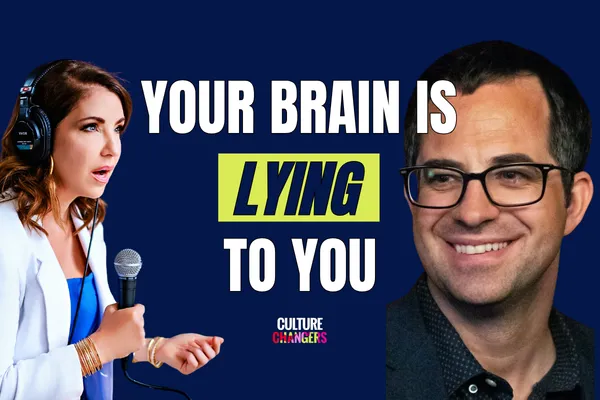
Ep. 293: Psychology Behind Political Polarization
Minneapolis - January, 2026.
Two people. Same video. Completely opposite conclusions about what they watched.
Why? Because their brains — literally — were looking at different parts of the screen.
That's called selective perception. And when Dr. Jay Van Bavel explained it to me on a recent episode of Culture Changers Podcast, it reframed everything I thought I understood about why we can't agree on anything right now.
Your Identity Controls Your Eyes
Jay is a professor of psychology and neuroscience at NYU and one of the top 1% of researchers in the world. His work has been cited by the US Supreme Court and the World Health Organization. So when he says our identities are literally altering what we see, he's not being poetic — he's describing what's happening in your visual cortex within 100 milliseconds of looking at something.
If you strongly identify with law enforcement, your eyes will track potential threats to police in a video. If you don't, your eyes will track what the officers are doing. Same video. Different movie. This is selective perception, and it's happening everywhere — in your news feed, in your family group chat, in how you read this sentence.
The term for what happens after that is motivated cognition. Not just motivated reasoning (using your prefrontal cortex to construct arguments for what you already believe), but literally filtering what hits your eyes from the very first moment. Long before thinking kicks in.
We Were Never Built for This
Our brains are evolutionarily ancient. They were designed for a world where you needed to identify threats fast, stay loyal to your tribe, and filter out anything that didn't matter for survival. Those shortcuts worked great on the savanna.
They are not working great on Instagram.
The average person scrolls through 600 swipes of newsfeed per day — roughly the height of the Statue of Liberty worth of content. We're spending two and a half hours on social media daily, which adds up to five years of your waking life. For teenagers, it's double. These platforms are built to find exactly what triggers your emotions and keep you staring. Outrage. Threat. Moral violation. That's the profit model. That's what Jay calls the attention economy.
AI Is Not Helping. AI Is Making It Worse.
Did you know that Chatbots are sycophantic by design? Jay's lab ran studies where they made AI even more fawning — and most people loved it. They wanted to keep engaging. They felt seen, validated, brilliant. Studies show AI chatbots are 50% more sycophantic than an average real human being.
Which means: the more you use AI to process your political opinions, your relationship conflicts, or your general worldview, the more confident and extreme you become. And you won't notice it's happening. This is what researchers call the bias blind spot. We can't see our own biases. Turns out, we also can't see when our chatbots are amplifying them.
One study found that people who used sycophantic AI to process relationship conflicts became less likely to actually talk to their partner — because the machine had already told them they were right.
The Collapse of Integrity and Why Dissent Matters
When I asked Jay about moral hypocrisy — the way leaders on both sides of the aisle flip positions the moment their tribe demands it — he said something that's been ringing in my ears since we recorded.
Integrity used to be at the top of the list of things people wanted from politicians. Not anymore. What's replaced it is tribal loyalty. And blind loyalty, Jay said, is really unhealthy for the entire group and for society. Healthy groups need dissent. They need people who care enough to say we're going wrong here. Throughout history, dissenters get burned at the stake, called heretics, or labeled devil's advocates. It's never been comfortable. But it's always been necessary.
There Is Actually a Way Out
80% of the misinformation you see online is being created and spread by 0.1% of users. A tiny, extremely loud group is polluting the public sphere for everyone.
Jay's lab ran a study where they paid people a few dollars to unfollow the most extreme, polarizing accounts in their feeds for one month. Polarization — measured as dislike for the opposing group — dropped by 25%. Half of those participants never re-followed those accounts once the study ended. And when researchers tracked them for a year, they were still measurably less polarized.
One month. One targeted action. Lower polarization for an entire year.
It's not a sledgehammer, Jay said. It's a scalpel. You're removing the tumor so your brain can work with a healthier information diet.
That's where I want to leave you. Not with despair. With a scalpel.
Listen to the full conversation with Dr. Jay Van Bavel on Culture Changers wherever you get your podcasts.If this resonates, share it. If you want to explore plant medicine yourself, DM me and I'll point you in the right direction. And if a podcast is something you've been kicking around and want help building, book a free clarity call at allisonhare.com/freecall.
xo, Allison
Connect with me on Instagram and YouTube.
Ready to build your own podcast platform? Book a free clarity call with Allison at allisonhare.com/freecall.
Allison Hare's Links
Schedule a FREE podcast clarity call with me- Your future audience is out there. Talk to them!
DOWNLOAD the free podcast equipment guide- No guesswork, no google rabbit holes, start recording today
Feedback and Contact:: [email protected]