Ep. 291: Are women disappearing again?
Women Are Getting Too Skinny — And This Time, We Have a Pill for It
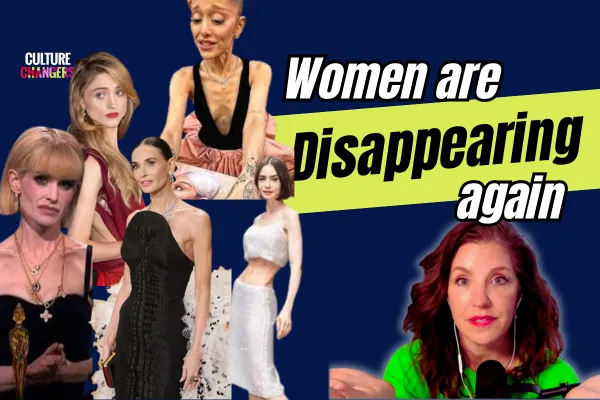
The women we saw at awards season 2026 looked gaunt. Not "naturally slender." Not "fit." Gaunt. Frail. Demi Moore. Kelly Osbourne. Ariana Grande. Cynthia Erivo. Lily Collins. Nicole Kidman. Bodies that telegraphed something, even if polite conversation wasn't supposed to name it.
We've been here before.
The '90s Called — And It's On the Line Again
The aesthetic had a name then: heroin chic. Sunken collarbones. Hollowed cheeks. Pale skin and stringy hair. Kate Moss as the template. The fashion industry rewarding bodies that looked like they were disappearing. Between 1990 and 1998, eating disorder rates in the US climbed sharply among 15–29 year olds. That was not a coincidence.
The '60s gave us Twiggy. The '90s gave us the waif model. And just when the culture seemed to shift — body positivity, plus-size representation, Lizzo saying F all y'all and meaning it — the pendulum swung back. Harder this time. And with pharmaceutical assistance.
The GLP-1 Revolution — And Who It's For
GLP-1 receptor agonists — Ozempic, Wegovy, Mounjaro, Zepbound — were developed to treat type 2 diabetes. They work by mimicking a hormone that suppresses appetite, slows digestion, and quiets what users describe as "food noise." They are remarkably effective. And women are using them at far higher rates than men.
According to RAND's 2025 survey of nearly 9,000 Americans, women between 30 and 49 are more than twice as likely as men to have used a GLP-1. About one in five women between 50 and 64 have used them. A Johns Hopkins Bloomberg School of Public Health analysis found that women lose an average of 11% of their starting body weight on these drugs, compared to 7% for men — a difference researchers link to how estrogen interacts with the medication.
The market has exploded accordingly. Novo Nordisk reported $31.1 billion in revenue from its GLP-1 drugs in 2024, up from $11.9 billion in 2022. Nearly 70% of those sales happened in the US.
This is a cultural force.
The Part Nobody Is Saying Out Loud
I am on a GLP-1. I got on one about a year ago — primarily for hormonal reasons, hot flashes specifically, and yes, I also wanted to lose about 10 pounds. I did. And I've been thinking about this episode ever since.
Because I also have a history of body dysmorphia, disordered eating, and orthorexia. Orthorexia is less about not eating and more about an obsessive, consuming relationship with food, exercise, and control. At my worst, I was at the gym at 5am doing heavy lifts, tracking every bite in MyFitnessPal, meal prepping food I didn't even want to eat, and feeling genuinely afraid of attending a dinner party because I couldn't control what would be served.
I was 115 pounds. I had a tummy tuck that went so wrong it left a hole in my stomach down to the muscle — a condition called necrosis, where the tissue dies. Three corrective surgeries. A medical suction device I had to hide under blazers in corporate meetings. And I still could not see myself clearly.
That's body dysmorphia. It's a funhouse mirror that no amount of thinness resolves — because the goal keeps moving.
And that is the mechanism that makes GLP-1 drugs, in the wrong hands or without the right support, genuinely dangerous for people who are already in a complicated relationship with their bodies.
The Medical Case for Concern
The National Eating Disorders Association has issued formal guidance: GLP-1 drugs may worsen the cognitive and behavioral symptoms of eating disorders, including body image distortion, drive for thinness, over-exercising, and meal-skipping. For people with restrictive eating disorders, particularly atypical anorexia — where someone restricts severely but doesn't present as medically underweight — these drugs can be catastrophic. And no national clinical guidelines currently require physicians to screen for eating disorders before prescribing them.
NPR's February 2026 investigation documented a patient with anorexia and a BMI of 16 — equivalent to a 90-pound person who is 5'3" — who had been obtaining GLP-1 drugs online by lying about her weight. She was in medical crisis.
Dr. Kim Dennis, an eating disorder specialist, put it this way: we need to hold two truths at once. GLP-1s are legitimate, evidence-based treatments for obesity. And they exist inside a culture that has intense weight pressure, weight stigma, and eating disorder risk. Both are true.
The physical risks extend beyond the psychological. Research presented at the American Academy of Orthopaedic Surgeons' 2026 annual meeting found a 30% higher relative risk of osteoporosis in GLP-1 users over five years compared to nonusers. Rapid weight loss without resistance training accelerates muscle loss, which increases bone fragility — particularly in postmenopausal women. When I look at Demi Moore — who once did one-arm pushups in G.I. Jane — and see no visible muscle on her body, I think about what her bones look like at her age. That is physiology.
Serena Williams Can't Win
Serena Williams is the sharpest possible example of what this culture does to women's bodies.
She was celebrated for her physicality in a way that was genuinely radical for women in sports — thick, powerful, muscular, strong. Her body was her instrument. 23 Grand Slam titles. Four Olympic gold medals. And also: constantly criticized. Too big. Too strong. Too Black. Too much.
Then she got on a GLP-1 — disclosed it publicly as a spokesperson for telehealth company Ro, where her husband is also an investor — and lost over 30 pounds. And she was shamed for that too. "The greatest tennis player of all time using Ozempic." Disgusting. She can't win. She has never been able to win. And this is a story about what we do to women.
Oprah Said It Best
Oprah Winfrey has had her body treated as public property for four decades. In 1988, she wheeled a wagon of 67 pounds of fat onto her stage in triumph. The internet never let her forget it. She was the spokesperson for Weight Watchers. She yo-yoed publicly, endlessly. And she has been both a participant in and a victim of diet culture.
When she finally began using a GLP-1 in late 2023, she said: "I want to acknowledge that I have been a steadfast participant in this diet culture. I've been a major contributor to it."
She also said something that lands differently once you understand how body shame works: she still felt the need to secretly quit the medication on her 70th birthday to prove she didn't need it. She regained weight. She went back on. She now says it's a lifetime commitment — not unlike any other medication for a chronic condition.
And still, psychologist and body image coach Bri Campos said it plainly: Oprah is one of the most influential people in the world, and her body has still been scrutinized relentlessly. That is "a reminder to powerful women that their body size, clothing, and adherence to beauty standards will stay a priority." Diet culture, Campos says, functions as a check on power.
This Is Political
This is a pattern.
The cultural pressure on women to shrink — to be thinner, quieter, smaller, less — does not happen in a vacuum. We are living through a documented rise in Christian nationalism in American political life, a movement with explicit positions on women's roles: domestic, deferential, thin, young, and silent. The aesthetic ideal being normalized right now is not separable from the political moment producing it.
When we celebrate women's disappearance as beauty and pathologize their visibility as vanity or excess, we are doing ideological work. Whether or not any individual woman making herself smaller intends that — and most don't, most are just trying to navigate a world that has always been unkind to their bodies — the cultural impact is cumulative.
The messaging is consistent: take up less space.
What Healthy Actually Looks Like
I don't have a clean answer. I want to be honest about that.
I am on a GLP-1 and I don't intend to apologize for it. I also have a responsibility to myself — given my history — to stay in honest relationship with why. Not to use it as a vehicle back into the obsessive, controlling, punishing relationship with my body that I worked so hard to get out of.
What I do know: 69–84% of women in the United States report body dissatisfaction. That is not a personal failure at that scale. That is a system problem.
If we are going to have a culture worth living in — for ourselves and for the girls who are watching us — we have to be willing to name what we see. Not to police each other's bodies. But to refuse to look away when the mirror is showing us something that deserves a real conversation.
Connect with me on Instagram and YouTube.
Ready to build your own podcast platform? Book a free clarity call with Allison at allisonhare.com/freecall.
Allison Hare's Links
Schedule a FREE podcast clarity call with me- Your future audience is out there. Talk to them!
DOWNLOAD the free podcast equipment guide- No guesswork, no google rabbit holes, start recording today
Feedback and Contact:: [email protected]