Ep. 289: The Pitt is the show America needs right now
Why The Pitt Is the Most Patriotic Show on TV Right Now
A New York Times columnist named Frank Bruni recently made a claim that stopped my scroll: The Pitt is the most patriotic show on American television today. Not Yellowstone. Not Succession. An ER drama set in Pittsburgh.
My first reaction was huh. My second reaction, after reading the piece and sitting with it, was: he's right.
Here's why.
What Is The Pitt, For the Uninitiated
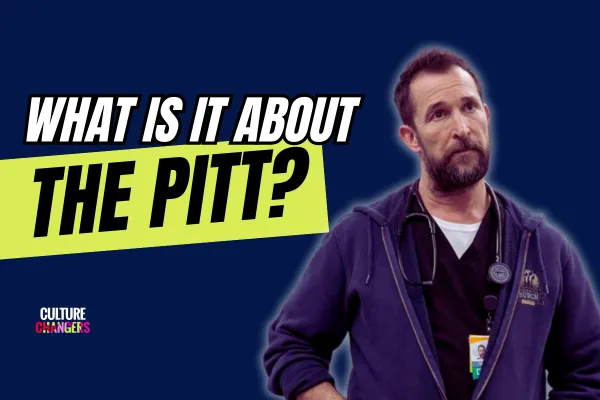
The Pitt is an HBO series starring Noah Wiley as Dr. Michael Rabinovich — Dr. Robby — an attending physician at an overwhelmed emergency department in Pittsburgh. Each episode covers one real-time hour. No flashbacks. No time jumps. The entire season is a single 15-hour shift.
It's intense. It's detailed. Real emergency medicine doctors consult on every episode to make sure the procedures are accurate. From what I've heard from people with ties to the ED world, the chaos? Completely real. The pace of catastrophe? Maybe slightly compressed for drama. But the emotional and physical toll on the people working there? Absolutely authentic.
Noah Wiley is also an executive producer, and he made one bold creative decision: no score. No music. He wanted the drama to earn its emotional weight without manipulation. And it works.
Reason One: Collective Grief Is Real, and This Show Sees It
We are grieving. I don't think we talk about that enough.
Over the past decade — and especially in any Trump cycle — the pace of crisis has become genuinely disorienting. News that would have dominated a 24-hour cycle now has a shelf life of a few hours. Podcasts drop in the morning and are old news by afternoon. The communities and identities we thought we belonged to are fracturing or hardening. The institutions we trusted — schools, churches, the political process — feel unstable in ways they haven't before.
And then, every Thursday at 9 PM, a lot of us sit down to watch a medical drama full of intensity and loss to unwind from lives full of intensity and loss. Which is, objectively, a little weird. But also makes complete sense.
What The Pitt does is hold up a mirror to that grief. It shows us people — practitioners who are burnt out, emotionally wrung dry, giving everything they have in a system that is stretched past its limits — and it names what that feels like. It validates it. Watching people navigate what feels unnavigable can be genuinely comforting. It tells us: this is hard. You're not imagining it. You are not alone.
I had a conversation recently about where people get their news right now, and someone pointed out that when we fund independent journalists on Substack, we're essentially paying people to tell us what we want to hear. And I thought — yeah, sometimes. But also sometimes what I need is just to know I'm not crazy and I'm not alone. The Pitt does that for me in a way that doesn't feel like pandering. It feels like witness.
Reason Two: We Are Not Two-Dimensional Characters
The Pitt is a masterclass in nuance, and it delivers it through characters you cannot easily categorize.
Take Santos. She showed up in season one as a brand-new student doctor with borderline offensive nicknames for everyone and a personality that rubbed the whole ED the wrong way. Reddit is split: is she a sociopath or a compassionate survivor? I'm firmly in the Santos-is-a-badass camp. As the season unfolds, you start to understand that someone who sees abuse, trafficking, and danger where others don't is probably speaking from experience. The writing is that careful.
Then there's Louie. A beloved, heavyset recurring patient — jovial, warm, always at the ED because of his alcohol addiction. You root for him. And then he dies. His body just gives out. And it's only after his death that you learn why he drank: his wife and unborn child were killed in a car accident, and he never recovered. Just like that, a character you might have written off becomes a whole person with a whole tragedy. The show does this constantly, and it's one of the things it does best.
Dr. Mel King is perhaps the most beloved character across the entire internet — Taylor Dearden, Bryan Cranston's daughter, playing a doctor who is exceptional with patients on the spectrum because her own sister is, and because she may be neurodivergent herself. Her level of empathy is written as a feature, not an anomaly.
And then there's Ogilvy. The callous new student doctor. Asking a patient struggling with his weight whether he's on Ozempic. Suggesting they call the zoo for a CAT scan. Just standing there, saying it, while the patient apologizes for existing. The show doesn't excuse Ogilvy. But it also leaves open the question: is there something underneath it? A neurodivergence that explains, if not justifies? The show is generous in that way — it extends the question of nuance even to its most difficult characters.
The lesson it keeps returning to: don't make assumptions. Two things can be true at once. The person in front of you has a story you don't know yet.
Reason Three: We Need to See People Win
This one is simple and true: we love watching people overcome impossible situations. That's why we love medical dramas. Crime dramas. Court TV. True crime. We want to see someone stare down an impossible situation and find a way through.
Right now, in real life, a lot of us are staring down situations that feel impossible. Politically, economically, interpersonally. The things we counted on — stability, safety, certainty — are not as fixed as we thought. And there is something deeply comforting about watching a team of exhausted, imperfect, wildly different humans show up for each other, triage chaos, and find a way through — episode after episode, hour after hour, patient after patient.
The Pitt doesn't sugarcoat it. People die. Systems fail. Practitioners break down. But the message underneath all of it is: we can handle this. We can handle inconceivable things, together, even when we don't like each other, even when we don't understand each other. That is, as Frank Bruni argued, a profoundly patriotic message.
The Lore (Because We Have to Talk About It)
A few things I cannot leave on the table:
Nurse Dana's "Baby Jane Doe" accent is the cultural gift of the year. She's from Louisiana, went to a dialect coach for a Pittsburgh accent, and landed somewhere entirely her own. Reddit has assembled compilation videos of her saying "Baby Jane Doe" and people are absolutely feral about it. Justified.
The no-helmet motorcycle scene at the start of season 2 was apparently a major creative debate. Noah Wiley's reasoning traced back to Gene Wilder in Willy Wonka — the cane-and-limp entrance followed by the backflip, leaving the audience to wonder: can we trust this person? That deliberate destabilization of the halo effect is a thread woven through the entire show.
Speaking of the halo effect: we extend it to celebrities, leaders, doctors, anyone in a position of power or fame — and The Pitt is quietly, consistently interrogating it. Dr. Langdon is brilliant and recovering from pill addiction. Dr. Ala Hashimi is progressive and technologically savvy and also seems to have a history we haven't seen yet (my theory: something personal involving that mystery baby). Fan theories are running wild on Reddit, which I highly recommend for anyone who wants to go deep.
And Dr. Abbott. People love Dr. Abbott. People want Dr. Abbott to get with someone. The internet has opinions. I'll let you do your own research there.
Why This Matters Beyond the Show
One more thing that stuck with me: viewership of The Pitt has been connected to a real-world spike in organ donor registrations. The show tackled organ donation in season one, handled it honestly and without agenda, and people responded by signing up. That is what storytelling can do. That is what it does when it's told well.
We are in a tumultuous time. All of it is interconnected — our personal lives, our communities, our political moment. None of it is siloed. And the way through is together — not in a Pollyanna way, not pretending the differences don't exist, but in a we-have-to-figure-out-how-to-coexist-and-support-the-people-around-us way.
The Pitt is showing us exactly as we are. Broken systems. Deeply layered people. Catastrophe handled — sometimes masterfully, sometimes not — one moment at a time.
If you haven't watched it, start. And then come find me on socials at @Allison__Hare, because I want to talk about it.
Links and Mentions:
Watch HBO's The Pitt: https://play.hbomax.com/show/e6e7bad9-d48d-4434-b334-7c651ffc4bdf
Frank Bruni's Opinion Piece in the NYT on the Pitt: https://www.nytimes.com/2026/02/23/opinion/pitt-america-tv.html
Prestige TV's Podcast Episode Breakdown of the Pitt: https://youtu.be/8sB0lR0nKYk?si=nywnnbKi6CfNPk3N
Allison Hare's Links
Schedule a FREE podcast clarity call with me- Your future audience is out there. Talk to them!
DOWNLOAD the free podcast equipment guide- No guesswork, no google rabbit holes, start recording today
Feedback and Contact:: [email protected]